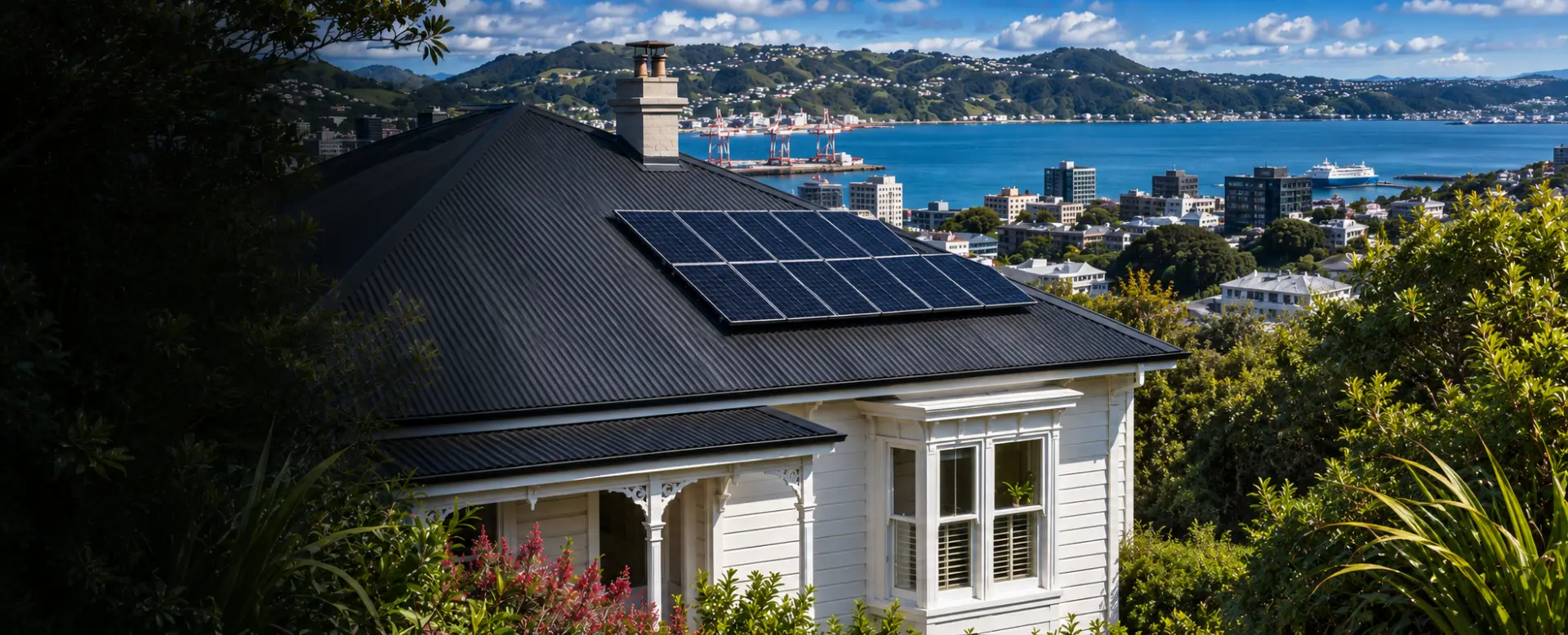
Wellington weatherboard villa with a dark long-run iron roof and solar panels above the harbour

Roofing and solar for Wellington, from one crew.

Leaks fixed, roofs replaced, and solar fitted to a roof built to outlast it.

Get a Free Quote

  • Roofing and solar in one job
  • Wellington wind and salt know-how
  • Photo report with every quote
  • Lower Hutt to Kapiti

Why Wellington homeowners choose a roofer who also fits solar

Roof and solar planned as one job

Most Wellington roofers do not install solar, and most solar installers are not roofers. That gap is where leaks start: panels bolted onto iron with a few years left, or penetrations sealed by someone who will not be back. We assess the roof first, tell you how long it has left, and only then plan the array. If a re-roof is due, both happen under one scaffold.

Source: BRANZ notes a re-roof is the right time to add solar, with panels fixed through to the rafters. BRANZ, Replacing a profiled metal roof

Specified for your street, not the brochure

A roof in Kelburn and a roof in Titahi Bay face different weather. We check your corrosion exposure zone and wind before choosing material, coating and fixings, and we say why in the quote.

Source: BRANZ advises against zinc and aluminium coated steel within 200 m of breaking surf. BRANZ, Replacing a profiled metal roof

A photo report with every quote

You see what we saw: rust, fixings, flashings, spouting, and the underside where we can reach it. Each quote says repair, restore or replace, with the reasons, so you can compare it fairly with anyone else's.

Standard: roof cladding must last at least 15 years under Building Code clause B2. MBIE, Building Code clause B2 Durability

Not sure if it is a repair or a new roof? We will tell you.

Send four details and we will call to book a look at the roof. You get photos and a written quote, with no obligation to go ahead.

Call 04 000 0000

What roofing problems do we fix in Wellington?

These are the faults we see most across the region's villas, bungalows, state houses and coastal homes.

Leaks at flashings, penetrations and valleys

Most roof leaks start where the sheet stops: around chimneys, skylights, vents, valleys and the ridge. Water tracks along purlins and shows up metres away, which is why patching the stain on the ceiling rarely works. We trace the path, replace or re-seal the flashing, and check the timber it has been soaking.

Building Code clause E2 requires roofs to stop water getting in and causing damage. (MBIE, Building Code clause E2 External moisture)

Wind-lifted iron and loose fixings

Wellington's northerly and southerly gales work fixings loose over time, starting at the edges and ridges where uplift is highest. Once a sheet lifts, rain is driven straight under it. We refix with the correct screws and washers and replace sheets that have been bent or torn.

NIWA describes Wellington as windy, with the strongest gusts around the south coast and Cook Strait. (NIWA, Wellington regional climatology)

Rust and corrosion on coastal roofs

Salt settles on the sheltered parts of a roof that rain never washes, under eaves, laps and overhangs, and that is where rust starts. Caught early it can be treated and recoated. Left alone it eats through the steel and the sheet has to be replaced.

BRANZ recommends washing painted metal roofs every year, or every 6 months in severe marine areas. (BRANZ, Replacing a profiled metal roof)

Cracked, slipped and broken tiles

Concrete and clay tiles crack under foot traffic, falling branches and age, and the mortar on ridges breaks down. We replace damaged tiles, rebed and repoint ridges, and tell you honestly when the roof is past patching and a change to metal makes more sense.

BRANZ notes that a tile-to-metal change needs the wind uplift on the new roof assessed. (BRANZ, Replacing a concrete or masonry tile roof)

Overflowing spouting and blocked downpipes

When spouting overflows, water runs down the cladding and into the wall framing instead of away from the house. Leaves, moss, sagging brackets and undersized downpipes are the usual causes. We clear, rehang, rejoin or replace runs so water leaves the roof where it should.

Spouting forms part of the roof's E2 job of keeping water out of the building. (MBIE, Building Code clause E2 External moisture)

Moss, lichen and organic growth

Moss and lichen hold moisture against the coating and the timber under it, and on tiles they lift the edges. Shaded roofs in Upper Hutt valleys and bush-backed sections are the worst. We treat the growth, wash the roof, and look for the damage it has hidden.

BRANZ says regular washing is part of keeping a painted metal roof's durability. (BRANZ, Replacing a profiled metal roof)

Asbestos-cement roofing on older homes

Some homes built before 1960 still have corrugated asbestos-cement roofing, sometimes hidden under a newer roof. It is stable while left alone but must not be cut, drilled or water-blasted. We arrange testing first and plan removal under the right controls.

BRANZ flags asbestos-cement roofing as a risk on pre-1960 houses. (BRANZ, Replacing a profiled metal roof)

What roofing and solar services do we offer?

From one loose sheet to a new roof with panels on it. Every job starts with the same thing: a look at the roof and a straight answer.

Solar panels fixed to a long-run metal roof in Wellington

Re-roofing

When rust has gone through, fixings are failing everywhere, or tiles are breaking faster than they can be replaced, a new roof costs less than years of patching. We strip the old roof, check and repair the framing and underlay, then fit new long-run metal with new flashings and spouting where needed.

Like-for-like re-roofing after at least 15 weathertight years may not need building consent, according to BRANZ. (BRANZ, Replacing a profiled metal roof)

Long-run metal roofing

Corrugated suits most villas and bungalows; trapezoidal profiles handle lower pitches and longer runs. We choose the profile from your roof pitch and the coating and fixings from your exposure zone.

BRANZ gives minimum pitches of 8 degrees for corrugated and 3 degrees for most trapezoidal profiles. (BRANZ, Replacing a profiled metal roof)

Roof restoration

A structurally sound roof with a tired coating can be cleaned, repaired, primed and repainted for a fraction of the cost of replacement. We only recommend it when the steel or tiles underneath have life left.

BRANZ links regular maintenance of painted metal to achieving its expected durability. (BRANZ, Replacing a profiled metal roof)

Solar panel installation

We design the array for your roof's orientation and pitch, fix the mounting rails through to the roof framing, and seal every penetration as roofers would. One crew is responsible for both the panels and the roof under them.

BRANZ describes solar panels fixed through the roof to the rafters as the standard approach. (BRANZ, Replacing a profiled metal roof)

Re-roof and solar packages

If your roof is within a few years of replacement, doing both together saves a second scaffold, a second disruption, and the cost of lifting panels off later. The new roof is laid with the array planned in.

Roof cladding must meet a 15 year minimum durability, and panels often stay up longer. (MBIE, Building Code clause B2 Durability)

Roof inspections

Buying, selling, insuring or just worried after a storm? We get on the roof, photograph what matters, and write up the condition with a clear repair, restore or replace recommendation and rough cost range.

Building Code clause B2 sets 5, 15 and 50 year durability tiers depending on how hard a part is to replace. (MBIE, Building Code clause B2 Durability)

What Wellington homeowners say

We publish reviews from completed jobs here, unedited, with the suburb and the work done.

Reviews from our first Wellington jobs will appear here.

Each one names the suburb and the job.

No paid or edited reviews.

Roofing across the Wellington region

Same crew, same standard, from the south coast to Otaki. See every area we cover.

Wellington City

Hillside villas and bungalows from Brooklyn and Kelburn to Island Bay, Karori and the eastern suburbs, many on exposed ridgelines and close to the coast.

Lower Hutt

Flat valley streets of state houses and 1950s and 1960s homes, plus the bays around Eastbourne where salt spray is constant.

Upper Hutt

Further from the sea and cooler in winter, with sheltered sections where moss and lichen build up on shaded roofs.

Porirua

Coastal suburbs from Titahi Bay to Whitby and Pukerua Bay, with strong onshore wind and older long-run and tile roofs.

Kapiti Coast

Paraparaumu, Raumati, Waikanae and Otaki, where beachside homes face sea spray and sunnier inland roofs suit solar.

Frequently asked questions

How much does a roof repair cost in Wellington?

It depends on what has failed and how hard it is to reach. A loose flashing or a few replacement fixings is a small job; a rusted valley or lifted sheets on a steep two-storey roof needs scaffolding and more time. We look first, photograph what we find, and give you a written price before any work starts.

Should I repair, restore or replace my roof?

Repair when the damage is local and the rest of the roof is sound. Restore when the roof is structurally fine but the coating is tired. Replace when rust has gone through the steel, fixings are failing across the roof, or tiles are breaking faster than they can be patched. Your photo report shows which of the three applies and why.

Do I need building consent to replace my roof?

Often not. BRANZ notes that replacing a roof with a comparable material, where the old roof has been weathertight for at least 15 years, may be exempt under Schedule 1 of the Building Act. Changing material, such as heavy tiles to metal, or altering the structure can need consent. We check with your council before work is booked.

Can you install solar panels on an older roof?

We can, but we check the roof first. Solar panels are usually on a roof for 20 years or more, so fitting them to iron that is close to the end of its life means paying to lift them off again later. If the roof has years left we fit the panels; if it does not, we quote the re-roof and solar together.

Will solar panels stay put in Wellington wind?

They need to be fixed properly. NIWA records Wellington as one of the windiest parts of New Zealand, so we mount panels through the roof cladding into the rafters or purlins, as BRANZ describes, rather than relying on the roofing sheets alone, and we seal every penetration.

Is my old roof asbestos?

It might be. BRANZ advises that houses built before about 1960 can have roofing containing asbestos cement, sometimes hidden under a later roof. If your home is in that age bracket we arrange testing before any cutting or drilling, and asbestos removal is carried out under the required safety controls.

Which areas do you cover?

Wellington City, Lower Hutt, Upper Hutt, Porirua and the Kapiti Coast, from Island Bay to Otaki. Call us if you are just outside those areas and we will tell you straight away whether we can help.

Got a leak or a roof question?

Call now, or send a few details and we will call you back with next steps.